https://www.jthughes.co.uk/Blog/View/BBC-warns-drivers-about-keyless-car-theft-Here-s-how-to-reduce-the-risk/13126
BBC warns drivers about keyless car theft. Here's how to reduce the risk.
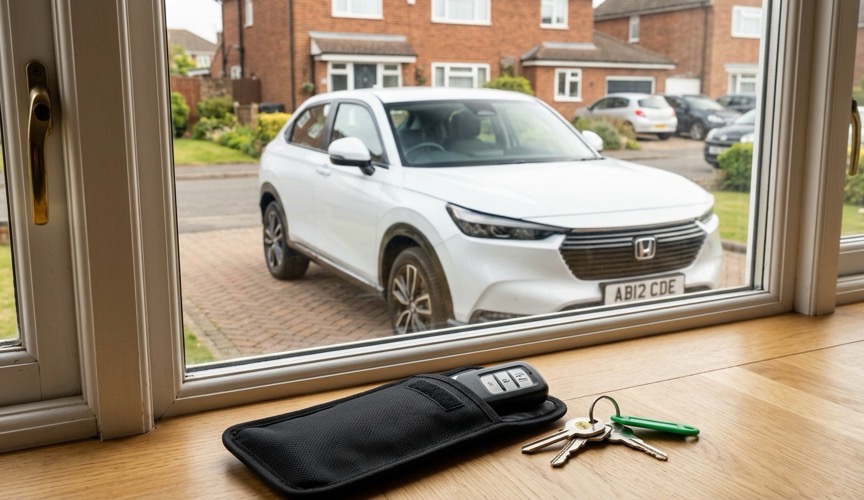
Faraday pouch and Honda key on a kitchen worktop, with the car just outside. A simple habit that reduces keyless theft risk.
The BBC ran a story on 13 April about keyless car thefts.
Your eyes drift to the hallway table.
That is where the keys live.
You are not the first.
Many drivers had the same thought this week.
Most of them still have their car on the drive
Keyless car theft is not a reason to panic.
It is a reason to change a few habits.
By the end you will know what a relay attack is, the habits that cut the risk, what to ask when buying keyless entry, and what to do if it happens.
No jargon. No scare tactics.
Just the version from people who work with these cars every day.
What keyless car theft actually is
Two people. About half a minute.
One stands near your house with a device that picks up the signal your key fob is broadcasting.
It relays that signal through the wall to a second device by your car.
The car believes the key is there, unlocks, and the engine starts.
According to the Police Service of Northern Ireland, thieves only need to be within a few metres of your car key to capture the signal, even if it is inside your home.
No broken glass.
No alarm.
What we see lines up with the police description.
The loudest thing in the job is the engine turning over.
Why it matters, for owners and buyers
This is for current owners and anyone thinking about a keyless car.
The UK Government reports that an offender manipulated the signal from a remote locking device in 40% of thefts of a vehicle in England and Wales, rising to around 60% in London.
Customers ask whether their car is on the list.
The honest answer is that exposure is less about the car, more about where the keys sit.
The technology is not the problem.
The habits around it are.
What to ask before buying a keyless car
We get asked about security most weeks, usually in an apologetic voice, as if it were rude.
It is not.
Three things worth asking any salesperson, any brand:
- Does the fob have a motion sensor that sleeps when still?
- What is the vehicle's Thatcham security rating?
- Can keyless be switched off when you do not need it?
Every manufacturer handles it differently.
The point is not to pick a winner.
It is to ask before you sign.
Everyday habits that cut the risk
The customers who sleep soundest are not the ones who spent the most.
They are the ones who changed the routine.
Keep the key and the spare away from the front door and windows.
Most people store them within two metres of the letterbox. That is close enough.
Put the keys in a Faraday pouch, signal-blocking bag, or metal tin.
A decent one costs less than a tank of fuel.
Test it every few months, because pouches wear out and people stop checking.
The RAC recommends storing keys in protective cases well away from the vehicle.
Manually check the car has locked before you walk inside.
Signal jammers can block the lock command, so the car sits open all night and nobody knows until morning.
Do not leave spare keys, the V5, or valuables in the car.
A thief who gets in without the spare will take longer to start it.
A thief who finds the spare in the glovebox will not.
Park close to the house, or in the garage if you have one.
Distance from the road is distance from opportunity.
A tenner on a pouch against the cost of a car on a transporter.
Extra layers worth considering
Layered defence beats any one fix.
A visible steering wheel lock will not stop the unlock sequence.
But relay-attack thieves want silent and fast, and a lock on the wheel is neither.
It turns a thirty-second job into a noisy one, and noisy is what they avoid.
A Thatcham-approved tracker, usually category S5, gives you and the police a chance of getting it back.
We have seen recoveries inside a few hours when a tracker was fitted. Without one, the odds drop.
Any aftermarket security should be fitted by a qualified installer.
Your brand's service network can point you at approved options.
Three simple habits beats one clever gadget.
What to do if it happens
If it is happening, call 999.
If you find out after, call 101 or report at police.uk.
Contact your insurer as soon as you have the crime reference.
Have ready: registration, make and model, policy number, tracker details, last known location.
People who come to us after a theft say the same thing.
A stressful morning is a bad time to hunt for a policy number. Five minutes now saves a difficult phone call later.
A quick checklist for tonight
What we suggest people run through before bed.
- Where are the keys sitting right now?
- Is the fob signal blocked, or is the pouch in a drawer?
- Do you check the car is locked before walking away?
- Any visible deterrent on the wheel or the drive?
- If buying keyless: have you asked about built-in security?
Five yeses is a hard target.
Most thieves want easy.
Keyless cars, in perspective
The keys are still on the hallway table.
That is fine, if the fob is in a pouch and the door is locked.
Keyless entry is not the enemy.
It is technology that benefits from a few small habits.
Go.Compare's April 2026 research found that 16% of keyless car owners keep their keys near a door or window. A further 15% own a Faraday pouch but do not always use it. Another 15% take no precautions at all.
As one of our advisors puts it, most of the job is not technical.
The BBC told you what was happening.
This piece was useful if it told you what to do.
A tenner, a pouch, a lock on the wheel.
That is most of the job done.